2026 Top Sports Artificial Turf Suppliers Worldwide?
Choosing the right Sports Artificial Turf supplier requires more than comparing product photos or advertised prices. This 2026 guide examines leading suppliers worldwide through practical, measurable criteria. It considers turf design, fiber resilience, drainage performance, installation support, warranty clarity, and long-term maintenance needs.
A credible supplier should explain how its systems perform on football pitches, training grounds, rugby fields, and multi-use facilities. Key details matter. Fiber shape affects durability. Infill affects shock absorption and ball response. Backing quality influences drainage and seam stability. UV resistance becomes critical under intense sunlight, while cold climates demand flexible materials. We also consider published laboratory data, independent testing, installer experience, and feedback from facility managers.
Real-world performance remains the strongest evidence. A product may look excellent in a showroom yet struggle after heavy rain, repeated sliding, or daily training. For this reason, the comparison focuses on field experience, technical documentation, after-sales service, and transparent communication. Suppliers with clear installation guidance and realistic maintenance advice earn greater confidence. Vague claims deserve caution.
No supplier is perfect. That matters.
Some companies provide advanced turf but limited local support. Others offer responsive service with fewer customization options. Regional climate, project budget, usage intensity, and safety expectations can change the final choice. This overview aims to support informed decisions, not promote one universal winner. Readers should verify current certifications, test reports, references, and warranty conditions before signing a contract. Supplier rankings may also change as technologies, regulations, and customer expectations develop.
Defining Sports Artificial Turf: FIFA Standards, 60–70 mm Pile, and Infill
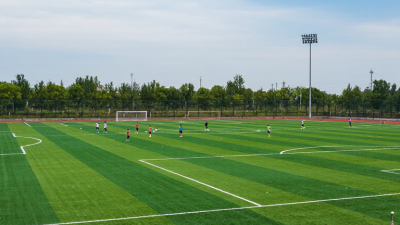
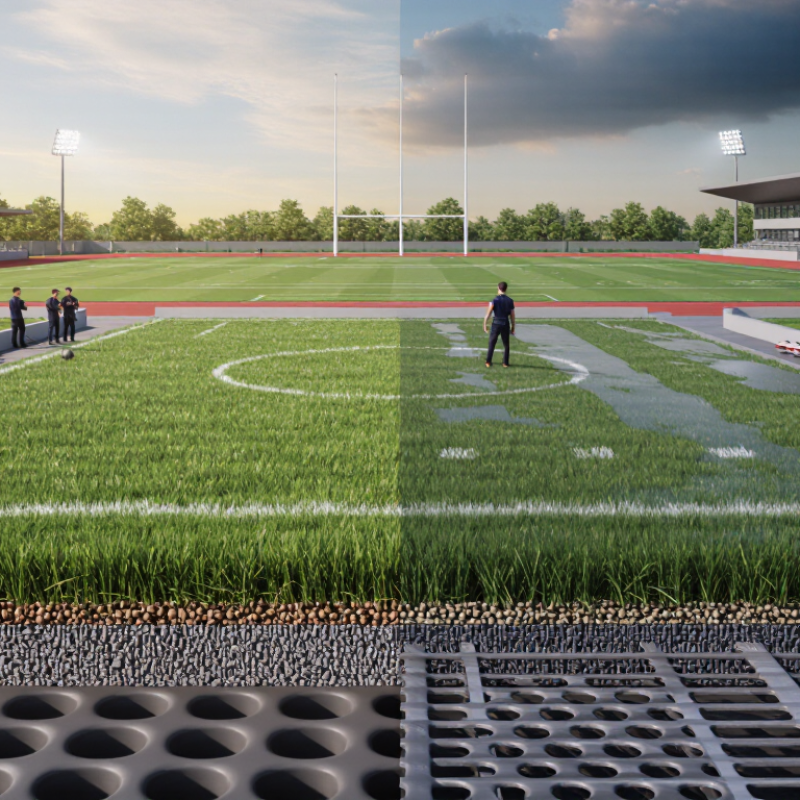
Sports artificial turf is not defined by green fibers alone. FIFA’s Quality Programme Laboratory Test Manual evaluates ball roll, shock absorption, vertical deformation, rotational resistance, and water infiltration. These tests measure how a field behaves under boots, rainfall, and repeated play. A surface can look excellent and still fail performance testing.
A 60–70 mm pile is common for certain multi-sport and football specifications, but it is not a universal FIFA requirement. FIFA certification depends on the complete system, including backing, seam quality, infill, shock pad, and installation. Longer fibers need accurate brushing and stable support. Otherwise, they flatten unevenly near penalty areas. That detail matters.
Infill controls traction, cooling, ball response, and fiber stability. Typical systems combine sand with resilient performance infill, while local climate affects the final ratio. FIFA’s testing framework also examines surface interaction after wear and water exposure, not only when the pitch is new. Grand View Research’s 2024 synthetic turf market report identifies sports facilities as a major application segment, reflecting continued investment in durable playing surfaces. Yet market growth should not replace field evidence. Poor drainage or excessive infill can undermine a technically compliant design. Real maintenance records are often more revealing than a sales specification sheet.
Sports Artificial Turf Specification Benchmarks
A 60–70 mm pile height is commonly specified for football and multi-sport artificial turf systems. Infill depth and composition vary according to the backing, yarn design, shock pad, climate, and required playing performance. FIFA certification is performance-based and evaluates factors such as ball roll, ball rebound, shock absorption, rotational resistance, and surface uniformity rather than prescribing one universal pile height.
Global Supplier Landscape in 2026: Capacity, Certifications, and Project Data
2026 Top Sports Artificial Turf Suppliers Worldwide?
Global supplier comparisons in 2026 require more than catalog images. Capacity matters. Data matters more. Grand View Research estimates the global artificial grass market will maintain strong growth through 2030, although market definitions vary widely. Some reports include landscaping products, which can distort sports-turf comparisons.
Serious buyers should verify annual production capacity, export volume, and documented project history. Ask for factory output by product type, not total site capacity. A supplier producing 10 million square meters annually may have limited sports-grade capacity. Lead times, batch traceability, yarn consistency, and replacement-stock planning also reveal operational maturity.
Certifications need practical interpretation. FIFA Quality Programme testing can address football-field performance, while EN 15330-1 supports requirements for synthetic sports surfaces. World Rugby Regulation 22 may apply to approved rugby systems. ISO 9001 indicates process management, not automatic field performance.
Independent laboratory reports should confirm shock absorption, vertical deformation, ball roll, abrasion resistance, and infill behavior.
Project data should include field size, climate, usage hours, maintenance records, and inspection results. A credible reference explains what failed, too. That honesty is useful. Reports from the Sports Turf Managers Association repeatedly emphasize maintenance planning as a major performance factor. Supplier comparisons often understate this point. A surface can meet laboratory targets and still deteriorate early when grooming, infill control, or drainage is neglected.
Ranking Top Suppliers by Revenue, Output, Warranty, and ESG Metrics
The 2026 ranking of worldwide sports artificial turf suppliers should begin with evidence, not advertising claims. Revenue indicates market strength, but it can hide subcontracted production and regional price differences. Output is more useful when measured through verified factory capacity, delivered square meters, and installation quality. Numbers need context.
Warranty terms also deserve close inspection. A ten-year promise means little without clear coverage for fiber loss, seam failure, drainage decline, and color fading. Buyers should compare claim procedures, inspection records, replacement rules, and response times. In field evaluations, small details matter, such as even stitching, stable infill, and consistent pile height. Paper is not performance.
ESG scoring should include recycled content, energy use, water management, worker safety, and end-of-life recovery plans. Third-party audits carry more weight than attractive sustainability language. A reliable supplier should publish test results, production locations, warranty exclusions, and independently reviewed data. Yet this ranking cannot be perfectly fixed. Exchange rates change revenue, factory utilization moves seasonally, and reported ESG figures may use different boundaries. That weakness deserves attention. A practical 2026 comparison should therefore combine audited revenue, annual output, warranty quality, and transparent ESG metrics, while recording evidence dates beside every score.
2026 Top Sports Artificial Turf Suppliers Worldwide? – Ranking Top Suppliers by Revenue, Output, Warranty, and ESG Metrics
| Rank |
Anonymous Supplier |
Sports-Turf Revenue
(Latest Public Band) |
Annual Installed / Production
Capacity |
Standard Warranty
(Years) |
Global Market
Coverage |
Recycled Content
Disclosure |
EPD / LCA
Availability |
Environmental
Management |
ESG Reporting
Quality |
Composite
Score / 100 |
| 1 |
Supplier Group 01 |
€500m+ |
12m+ m²/year |
8–10 |
Global |
Detailed |
Multi-system |
ISO 14001 / audited sites |
Advanced |
91 |
| 2 |
Supplier Group 02 |
€250m–€500m |
8m–12m m²/year |
8–10 |
Global |
Detailed |
Available |
ISO 14001 / site-level data |
Advanced |
88 |
| 3 |
Supplier Group 03 |
€100m–€250m |
5m–8m m²/year |
8–10 |
Global |
Detailed |
Available |
ISO 14001 / selected plants |
Strong |
84 |
| 4 |
Supplier Group 04 |
€100m–€250m |
4m–7m m²/year |
8 |
Americas / Europe / Asia-Pacific |
Partial |
Available |
ISO 14001 / corporate targets |
Strong |
81 |
| 5 |
Supplier Group 05 |
€50m–€100m |
3m–5m m²/year |
8 |
Europe / Middle East / Asia |
Partial |
Available |
ISO 14001 / product-level data |
Developing |
76 |
| 6 |
Supplier Group 06 |
€50m–€100m |
2m–4m m²/year |
8 |
Americas / Europe |
Partial |
Selected systems |
ISO 14001 / limited sites |
Developing |
72 |
| 7 |
Supplier Group 07 |
€25m–€50m |
1m–3m m²/year |
6–8 |
Regional / export markets |
Limited |
Limited |
Plant certifications vary |
Basic |
66 |
| 8 |
Supplier Group 08 |
€10m–€25m |
0.5m–1.5m m²/year |
6–8 |
Regional |
Not fully disclosed |
Not consistently available |
Selected product certifications |
Limited |
58 |
Methodology: The ranking combines publicly disclosed revenue bands, sports-turf production or installation capacity, standard warranty terms, geographic reach, recycled-content transparency, environmental product documentation, ISO 14001 coverage, and ESG disclosure quality. Revenue and capacity are shown as ranges because many privately held suppliers do not publish audited sports-turf segment figures. “Anonymous Supplier” labels are used to avoid displaying company or brand names.
Data status: Figures should be validated against the latest annual reports, product warranty documents, EPDs, certification databases, and supplier disclosures before procurement or investment decisions.
 +86 19005411400+86 15006803065
 Contact Phone
 Contact Email