+86 19005411400+86 15006803065


Choosing the Best Green Turf for Global Buyers
The best Green Turf is not always the darkest, softest, or most expensive option. It must survive the buyer’s real conditions. Climate, sunlight, soil drainage, foot traffic, irrigation quality, and maintenance skill all shape the decision. A product that performs beautifully in coastal England may struggle under intense heat in Dubai. A turf variety that tolerates drought may feel less dense under heavy sports use.
Dr. James B. Beard, a leading turfgrass scientist, expressed the essential principle clearly: “The right grass in the right place.” This idea remains practical for international buyers. Warm-season grasses, such as Bermuda grass and zoysia, often suit hot regions. Cool-season grasses, including fescue and ryegrass, may perform better in cooler climates. However, regional adaptation is only part of the assessment. Buyers should also examine root strength, recovery speed, color stability, water demand, disease resistance, and delivery quality.
The details matter.
Experienced buyers request trial samples before placing large orders. They inspect turf thickness, moisture, packaging, and uniformity after transport. Reliable suppliers should provide botanical names, growing conditions, maintenance guidance, and realistic performance data. Certifications and traceable production records can strengthen confidence, but they cannot replace local testing. That is an uncomfortable point. Marketing photographs rarely show winter damage, weak rooting, or uneven installation.
There is no universal winner. The smartest Green Turf choice balances appearance, performance, lifecycle cost, and local environmental pressure. Global buyers should remain curious, cautious, and willing to revise their first preference.
Green turf means more than a bright, uniform lawn. For global buyers, it usually describes a resilient playing or landscaping surface that remains visually green with limited irrigation. It can be natural grass, synthetic turf, or a carefully selected hybrid system. The definition matters. A green appearance alone does not prove environmental performance.
Water pressure strongly influences purchasing decisions. The United Nations World Water Development Report 2024 states that agriculture accounts for about 70% of global freshwater withdrawals. In dry regions, reducing lawn irrigation can therefore support more practical water planning. Grand View Research reported that the global artificial turf market was valued at approximately USD 3.6 billion in 2023, with continued growth expected through 2030. Buyers also value consistent color, fewer muddy areas, and predictable maintenance after heavy use.
Performance appears in small details. A quality surface should recover after foot traffic, drain rain quickly, and remain comfortable during hot afternoons. However, the calculation is not perfect. Synthetic turf can reduce watering, yet its manufacturing, heat retention, infill, and end-of-life handling require careful review. I would not call every green surface sustainable. Global buyers should request test data, drainage results, UV-resistance evidence, maintenance records, and clear material disclosures. The best choice depends on climate, usage, installation quality, and disposal planning—not color alone.
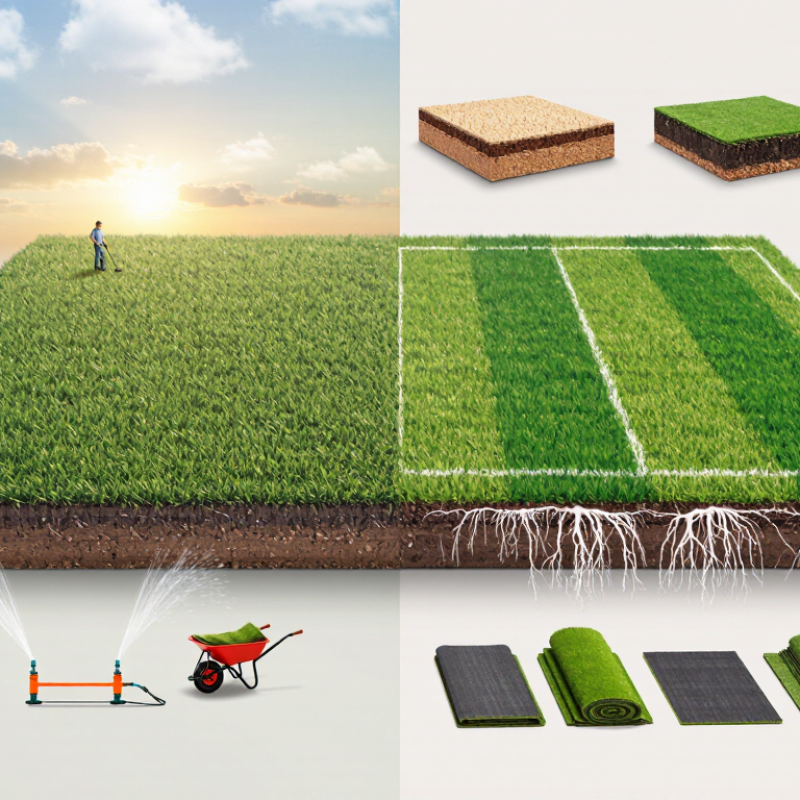
Green turf is not one universal product. Natural grass remains common in professional football, golf, parks, and luxury landscapes. It offers cooler surfaces and authentic ball response, but needs irrigation, mowing, and seasonal recovery. Synthetic turf suits stadiums, schools, rooftops, playgrounds, and dry regions. Grand View Research’s 2024 Artificial Turf Market report projects annual growth of nearly 7% through 2030. That rise reflects demand for lower routine maintenance and longer playing hours. Hybrid turf combines natural roots with synthetic reinforcement. It supports heavy traffic, although installation and repair can become more complex. No type wins everywhere.
Tips: Match turf to climate, usage, and maintenance capacity. Check drainage rates, heat performance, pile density, and local recycling options. For sports fields, review testing under FIFA Quality Programme standards. For landscaping, compare water savings against surface temperature and installation cost. Buyers often focus on appearance first. That can be a costly mistake.
Natural turf may reduce surface heat, but drought can quickly change its operating cost.
Synthetic turf saves mowing and watering, yet hot weather may require cooling measures.
The Sports Turf Managers Association repeatedly emphasizes testing, infill management, and scheduled maintenance for safer field performance. In my experience, the most reliable choice begins with daily use patterns, not showroom color. A bright green surface can still fail under poor drainage. Regional labor skills matter too. A technically strong product may underperform when installation guidance is ignored.
Turf quality begins below the surface. Check fiber material, pile height, stitch density, backing strength, and drainage design. FIFA’s Quality Programme Handbook uses ball roll, shock absorption, and vertical deformation as key football-turf tests. Its published criteria commonly examine ball roll between 4 and 8 metres, with controlled shock absorption and surface deformation. These figures help buyers compare products, but they do not replace site testing. A coastal field needs different protection from a dry, high-UV rooftop. I have seen attractive samples fail when poor drainage trapped water beneath the backing.
Durability requires evidence, not confident language. Ask for accelerated weathering results based on ISO 4892-3, plus abrasion and seam-strength records. Compare color change, fiber splitting, and pile recovery after repeated loading. A dense surface may look premium, yet dense fibers can flatten without suitable infill or maintenance. Appearance also changes under cloud, sunlight, and artificial lighting. Darker green is not automatically more natural. This comparison has a weakness: laboratory aging cannot fully copy monsoon rain, sand, frost, or heavy local use. Buyers should request installation references from similar climates and inspect older surfaces in person.
Tips: Request a cut sample with backing visible. Measure pile height with a ruler. Rub the fibers in opposite directions. Photograph the color under daylight. Confirm warranty terms, testing dates, and replacement-part availability before ordering. Never judge quality from showroom images alone.
What Is the Best Green Turf for Global Buyers?
Climate, Installation, and Maintenance Factors by Region
The best green turf depends on climate, ground conditions, and daily use. In hot, dry regions, choose fibers with strong UV resistance and heat-stable backing. Pale or blended tones can reduce the visual impact of surface heat. A properly compacted base also prevents waves after repeated foot traffic. Do not skip drainage. Dust can quickly block poorly designed systems.
Humid and tropical areas require fast water removal and mold-resistant materials. Install a sloped subbase, sealed seams, and enough drainage channels for heavy rain. Regularly rinse leaves, soil, and organic debris from the surface. In coastal locations, salt and sand need special attention. Sand can wear fibers when people drag furniture across the turf.
Cold regions create different problems. Freeze-thaw cycles can lift edges and crack weak foundations. Use flexible edging and allow water to escape before winter. Brush flattened fibers after snow melts, but avoid sharp tools and excessive force. Maintenance is regional, not universal. This is where many buyers misjudge the product. They compare fiber appearance but ignore local soil and weather records. I have seen attractive installations fail because the base was rushed. No turf can correct poor preparation. A small test area can reveal drainage, heat, and cleaning problems before full installation. Still, testing cannot predict every season. Local installers should review rainfall, sunlight, soil movement, and expected traffic before approving the final specification.
Climate, installation, and maintenance factors by representative region
Regional values are planning benchmarks based on representative climate conditions; actual performance depends on soil, shade, rainfall, irrigation efficiency, and turf cultivar.
Choosing the best green turf supplier starts with evidence, not attractive photographs. Global buyers should request a physical sample, technical datasheet, and recent independent test reports. A 30-centimeter sample can reveal backing quality, fiber density, color consistency, and drainage holes. Ask whether the turf is designed for gardens, sports areas, balconies, or commercial landscaping. Each application requires different performance standards.
Reliable suppliers explain their manufacturing process in clear language. They should provide fiber height, stitch rate, yarn structure, UV resistance, water permeability, and roll dimensions. Check batch traceability and inspect how the company handles production defects. A supplier that avoids difficult questions may create larger problems later. In my experience, small details matter, such as uneven roll edges or unclear installation guidance. These issues can increase labor costs across an entire project.
International purchasing also depends on practical support. Confirm packaging methods, loading capacity, lead times, replacement policies, and delivery documents before signing. Ask for installation instructions suited to your climate and ground conditions. Independent laboratory results are more useful than vague claims like “premium quality.” Local safety, fire, chemical, and environmental requirements may differ, so buyers should verify them with qualified specialists. No supplier is perfect. Even strong documentation may not predict every problem after heavy rain, intense sunlight, or frequent use. A trial installation can expose weaknesses before a full shipment arrives.
| Selection Dimension | Recommended Screening Benchmark | Why It Matters to Global Buyers | Evidence to Request from the Supplier | Buyer Evaluation Notes |
|---|---|---|---|---|
| Application and Traffic Level | Choose a product designed for landscaping, recreational use, or sports use according to the installation purpose. | Different applications require different yarn structures, backing systems, drainage designs, and wear resistance. | Product datasheet, application classification, abrasion or wear test report, and recommended-use statement. | Do not compare a decorative landscaping product directly with a sports surface product. |
| Pile Height | Common landscaping specifications are approximately 25–50 mm; sports systems may use different heights according to the sport and infill design. | Pile height affects appearance, resilience, infill demand, drainage behavior, and maintenance requirements. | Measured pile height, product drawing, installation instructions, and tolerance information. | A taller pile is not automatically better; the correct height depends on traffic, climate, and intended use. |
| Yarn Polymer | Polyethylene is widely used for soft, flexible landscaping and recreational surfaces; other polymers may be selected for specific performance needs. | Polymer type influences softness, resilience, color stability, heat behavior, and long-term wear. | Material declaration, technical data sheet, and documentation identifying the polymer used in the face yarn and backing. | Ask whether the stated polymer applies to the yarn, backing, or the complete product. |
| Yarn Shape and Construction | Compare monofilament, slit-film, and hybrid constructions using product-specific durability and appearance data. | Yarn shape affects recovery after compression, visual density, abrasion resistance, and maintenance needs. | Cross-section images, yarn construction details, tufting information, and independent test results where available. | Sample evaluation is important because laboratory data alone may not show the final visual effect. |
| Yarn Weight and Density | Use face weight, stitch rate, and tuft density together rather than relying on one figure alone. | Higher material density can improve coverage and durability, but it may also increase product weight, cost, and freight volume. | Face weight in g/m², stitch rate, tuft density, yarn thickness or dtex, and measurement method. | Figures from different suppliers are comparable only when the measurement definitions are the same. |
| Backing Strength | Require declared tensile strength, tear strength, and dimensional stability values tested under a recognized method. | The backing supports tuft retention and helps the installation resist movement, shrinkage, and handling damage. | Primary backing and coating details, tensile test report, tear test report, and dimensional-change data. | Check both the backing material and the coating because they perform different functions. |
| Drainage Performance | Select a perforated or permeable backing suitable for the project drainage design; verify the declared water-permeability value. | Good drainage helps reduce standing water, surface odor, freeze-thaw stress, and installation problems. | Water-permeability test result, perforation pattern, installation section, and sub-base drainage requirements. | Turf drainage depends on the complete system, including the base, seams, slope, and local soil conditions. |
| UV and Color Stability | Request accelerated weathering or color-fastness data using a recognized standard, such as ISO 105-B02 where applicable. | Strong sunlight, high temperatures, and seasonal exposure can cause fading and polymer degradation. | UV-aging report, color-fastness rating, test duration, exposure conditions, and warranty limitations. | Confirm that the test conditions are relevant to the installation region and expected service life. |
| Flammability and Fire Classification | Require compliance with the fire-performance requirements applicable to the destination country and end use. | Building regulations, public-use requirements, and installation substrates can affect the required fire classification. | Fire test certificate, classification report, test standard, backing configuration, and installation conditions. | A fire rating applies to the tested system; changing the underlay or infill may change performance. |
| Chemical and Heavy-Metal Safety | Request material safety testing appropriate to the market, including restricted-substance and heavy-metal screening where required. | Safety requirements are especially important for playgrounds, schools, public areas, and projects with strict import rules. | Restricted-substance declaration, laboratory report, safety data, and test scope covering yarn, backing, coating, and infill. | Confirm the report is for the current product and production batch or a controlled equivalent. |
| Temperature and Climate Suitability | Evaluate heat retention, cold flexibility, UV exposure, rainfall, snow, and freeze-thaw conditions for the destination climate. | Climate affects surface temperature, expansion, drainage, material aging, and user comfort. | Climate suitability statement, thermal data where available, installation guidance, and regional project references without brand disclosure. | For hot climates, assess surface-temperature management, shade, irrigation, and user-contact requirements. |
| Infill Compatibility | Confirm the approved infill type, quantity, particle size, and maintenance procedure for the selected turf system. | Infill influences blade support, drainage, shock absorption, heat behavior, odor control, and maintenance. | Installation manual, infill specification, recommended application rate in kg/m², and compatibility statement. | The same turf may perform differently when installed with a different infill or without the specified infill. |
| Seam and Installation System | Require a documented installation method covering seams, edges, joins, base preparation, and drainage. | Many visible failures result from poor preparation or installation rather than from the turf material itself. | Installation manual, seam-test data, adhesive or joining-system specification, and installer training requirements. | Ask for a complete system quotation instead of comparing the turf roll price alone. |
| Quality Control and Traceability | Prefer suppliers that can identify production lots, retain samples, control raw materials, and document inspection procedures. | Traceability helps resolve color variation, dimensional differences, defective rolls, and repeat-order issues. | Quality-control plan, inspection checklist, lot coding method, sample-retention policy, and corrective-action process. | Verify that pre-shipment inspection covers roll length, width, weight, color, backing, and visible defects. |
| Sample and Pre-Production Approval | Approve a physical sample and, for large projects, a representative mock-up before mass production. | Samples reveal color, shine, softness, density, backing quality, and seam appearance more reliably than photographs. | Signed sample approval, approved specification sheet, reference sample, and change-control procedure. | Keep a sealed reference sample for comparison during production and delivery inspection. |
| Packaging and Export Readiness | Confirm roll dimensions, net and gross weight, moisture protection, loading method, and shipping marks before ordering. | Packaging affects container utilization, damage risk, customs handling, and delivered cost. | Packing list, roll-size schedule, loading plan, moisture-protection details, and export document checklist. | Compare delivered cost per square meter, not only the ex-works or factory price. |
| Warranty and After-Sales Support | Require a written warranty with product scope, service-life assumptions, exclusions, claim procedure, and response times. | A clear warranty reduces uncertainty when defects, fading, delamination, or installation disputes arise. | Warranty document, claims process, replacement policy, technical-support contact, and maintenance obligations. | Check whether the warranty depends on approved installation, cleaning, infill, drainage, or climate conditions. |
| Total Cost of Ownership | Compare purchase price, freight, duties, installation, infill, drainage preparation, maintenance, and expected replacement timing. | The lowest unit price may result in higher lifecycle costs if the product requires more maintenance or fails earlier. | Full bill of quantities, installation estimate, maintenance schedule, replacement assumptions, and landed-cost calculation. | Use the same area, currency, shipping basis, tax treatment, and service assumptions for every quotation. |